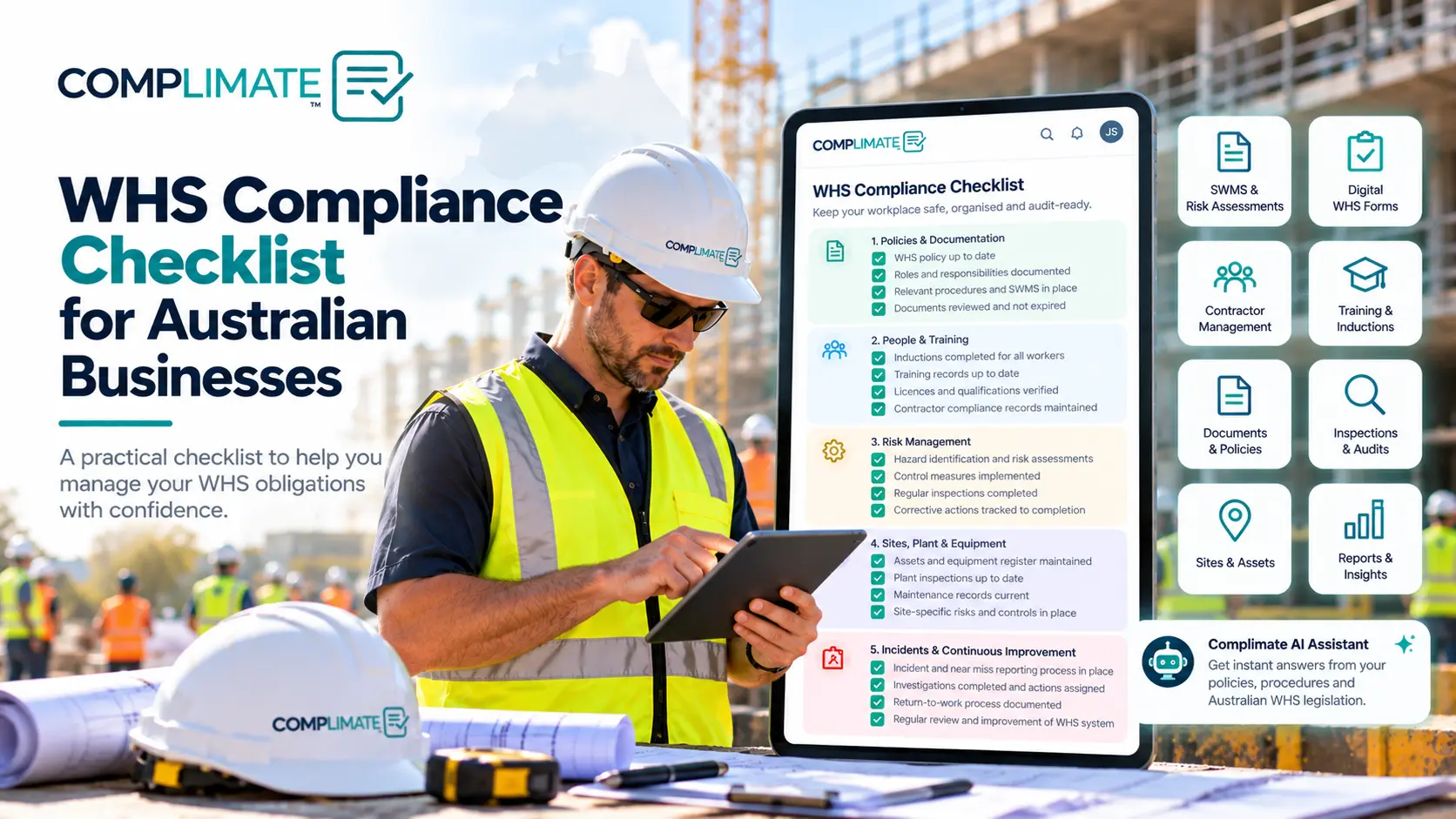
Work health and safety (WHS) compliance helps Australian businesses manage workplace risks, protect workers and maintain important safety records. However, keeping policies, inspections, training records and corrective actions up to date can be difficult when information is spread across spreadsheets, emails and paper forms.
This WHS compliance checklist for Australian businesses provides a practical starting point for reviewing your safety management processes. It covers workplace hazards, risk assessments, worker training, incident reporting, contractor management and documentation.
The checklist is a general guide, not a guarantee of legal compliance. Your actual requirements depend on your industry, activities, workplace risks and applicable state or territory laws.
WHS Compliance Checklist: Key Areas to Review
Use this checklist to identify gaps in your current workplace health and safety processes.
Workplace hazards are identified and risks are assessed.
Appropriate risk controls are implemented and reviewed.
WHS policies and procedures reflect current work activities.
Workers receive suitable information, training and supervision.
Workers are consulted about relevant health and safety matters.
Emergency plans, first aid arrangements and equipment are reviewed.
Incidents, injuries, hazards and near misses can be reported.
Corrective actions have assigned owners and due dates.
Contractor qualifications, licences and safety documents are checked where required.
Plant, equipment and relevant maintenance records are maintained.
Required WHS documents are accessible and current.
Safety inspections and internal reviews are completed at suitable intervals.
Not every item will apply in the same way to every business. Review each area against your actual work activities and legal obligations.
1. Identify Workplace Hazards and Assess Risks
A key part of WHS management is identifying anything that could cause injury or illness and taking suitable steps to eliminate or minimise the risk.
Review whether your business has a process to:
Identify physical, chemical, biological and psychosocial hazards.
Assess risks where necessary.
Implement suitable control measures.
Consult workers who may be affected.
Review controls when work conditions change or controls are no longer effective.
For example, a construction business may need to assess risks involving falls, mobile plant, electrical work and hazardous materials. An office-based business may need to consider workstation ergonomics, work-related stress and emergency access.
Safe Work Australia explains the general risk management process and PCBU duties.
2. Review WHS Policies, Procedures and Documents
Your WHS documents should reflect how work is actually performed. A policy that exists on paper but is outdated, inaccessible or not followed may not provide effective support for your safety management system.
Check whether you maintain and review relevant documents, such as:
WHS policies and procedures.
Risk assessments and safe work method statements (SWMS), where required.
Emergency response plans.
Inspection checklists and maintenance records.
Training, induction and competency records.
Hazard, incident and corrective action registers.
Relevant licences, certificates and contractor documents.
Assign responsibility for document reviews and track expiry or review dates where applicable.
A central document management process can help teams find the correct version and reduce the risk of relying on outdated records. Learn how Complimate's safety management software helps businesses organise safety documents, audits and compliance workflows.
3. Check Worker Training, Inductions and Consultation
Workers need suitable information, training, instruction and supervision for the work they perform. Businesses should also consult workers about health and safety matters that directly affect them.
Review the following:
New workers receive relevant workplace inductions.
Training and competency requirements are identified for each role.
Required licences and qualifications are checked.
Refresher training is arranged where needed.
Workers know how to report hazards and incidents.
Consultation arrangements allow workers to raise safety concerns.
Relevant health and safety representatives are involved where required.
If contractors or other businesses share responsibility for workplace risks, make sure relevant parties communicate and coordinate their activities.
Read Safe Work Australia's guidance on WHS consultation for more information.
4. Review Incidents, Hazards and Corrective Actions
Reporting an incident is only one part of effective incident management. Businesses also need to assess what happened, address underlying causes where appropriate and review whether additional controls are needed.
Check whether your process allows you to:
Record incidents, injuries, hazards and near misses.
Capture relevant details, photographs and supporting evidence.
Investigate incidents where appropriate.
Assign corrective actions to responsible people.
Set due dates and monitor outstanding actions.
Verify whether completed actions are effective.
Identify repeated issues and emerging patterns.
For example, if an inspection identifies damaged equipment, record the finding, assess the risk, arrange appropriate controls and track the required action through to completion.
Some serious workplace incidents must be reported to the relevant WHS regulator. Notification requirements depend on the applicable laws and circumstances. Consult Safe Work Australia's incident notification guidance and your local regulator.
5. Inspect Equipment, Worksites and Contractors
Businesses should consider the risks associated with their sites, equipment and the people performing work on their behalf.
Use the following prompts to review your arrangements:
Workplace inspections are completed at appropriate intervals.
Equipment maintenance and inspection records are maintained where required.
Defects are reported and addressed.
Contractor safety requirements are identified before work begins.
Relevant contractor licences, qualifications, inductions and documents are checked.
Site-specific risks and emergency arrangements are communicated.
Responsibilities are coordinated when multiple businesses share WHS duties.
The checks needed will depend on the work being performed. Construction, childcare, healthcare and office-based businesses may have very different hazards and operational requirements.
6. Prepare for WHS Audits and Reviews
A WHS audit or internal review can help identify gaps in your processes and check whether existing controls are working.
Before a review, confirm that you can locate relevant documents, inspection records, training evidence, incident reports and corrective action records.
Also check whether:
Responsibilities are clearly assigned.
Previous findings have been addressed.
Overdue actions are reviewed and escalated.
Documents reflect current work activities.
Repeated problems are investigated.
Changes in work, equipment or legislation trigger a review when appropriate.
Keep evidence of decisions, actions and reviews. This helps demonstrate how your business manages safety matters and supports continuous improvement.
How Can WHS Compliance Software Help?
Spreadsheets and shared folders may be enough for some basic processes. However, as a business grows or manages multiple sites, keeping documents, inspections, incidents and corrective actions connected can become harder.
WHS compliance software can help businesses organise these processes by providing a central place to manage:
Safety documents, policies and procedures.
Digital forms, inspections and audit records.
Hazard and incident reports.
Corrective actions, owners and due dates.
Contractor and worker compliance records.
Equipment, site and maintenance information.
For example, an inspection finding can be recorded and linked to a corrective action, assigned to a responsible person and tracked until it is reviewed.
Complimate brings these types of workflows together through its WHS and compliance management software. Businesses should still verify their legal obligations, assess risks and make appropriate decisions. Software supports the process; it does not transfer or remove a business's WHS duties.
Frequently Asked Questions
What should a WHS compliance checklist include?
A WHS compliance checklist should cover hazard identification, risk management, policies and procedures, training, worker consultation, emergency arrangements, incident reporting, corrective actions, contractors, equipment and relevant records. The exact checklist should reflect the business's risks and applicable laws.
Is a WHS compliance checklist a legal requirement in Australia?
A single universal checklist is not a substitute for meeting WHS legal duties. Businesses must identify and meet the requirements that apply to their activities and jurisdiction. A checklist is a practical way to review whether important processes and records are in place.
How often should a WHS checklist be reviewed?
Review it at intervals appropriate to your workplace risks and business activities. Also review it after significant changes, incidents, identified control failures or changes to applicable requirements. Some specific activities and records may have their own legal review or inspection requirements.
What is the difference between a WHS checklist and a WHS audit?
A checklist is a structured list of items to verify. A WHS audit is a more detailed review of whether relevant requirements, procedures and controls are in place and working effectively. A checklist may form part of an audit.
Can small businesses use WHS compliance software?
Yes. Small businesses can use WHS compliance software to organise documents, track actions, manage inspections and maintain records. The right solution depends on the business's risks, size, budget and operational needs.
Does WHS software guarantee compliance?
No. Software can help organise information, track tasks and support compliance processes, but it cannot guarantee that a business meets every legal obligation. Businesses remain responsible for identifying applicable requirements, managing risks and ensuring their processes work in practice.
Final Thoughts
A useful WHS compliance checklist gives Australian businesses a clear way to review their safety processes, identify gaps and follow up on outstanding actions. The most important step is not simply ticking boxes; it is making sure hazards are managed, workers are consulted and safety controls remain effective.
Start by reviewing the checklist above, assigning responsibility for any gaps and setting realistic dates for follow-up. As your processes grow, consider using Complimate's safety management software to help organise documents, audits and corrective actions in one place.