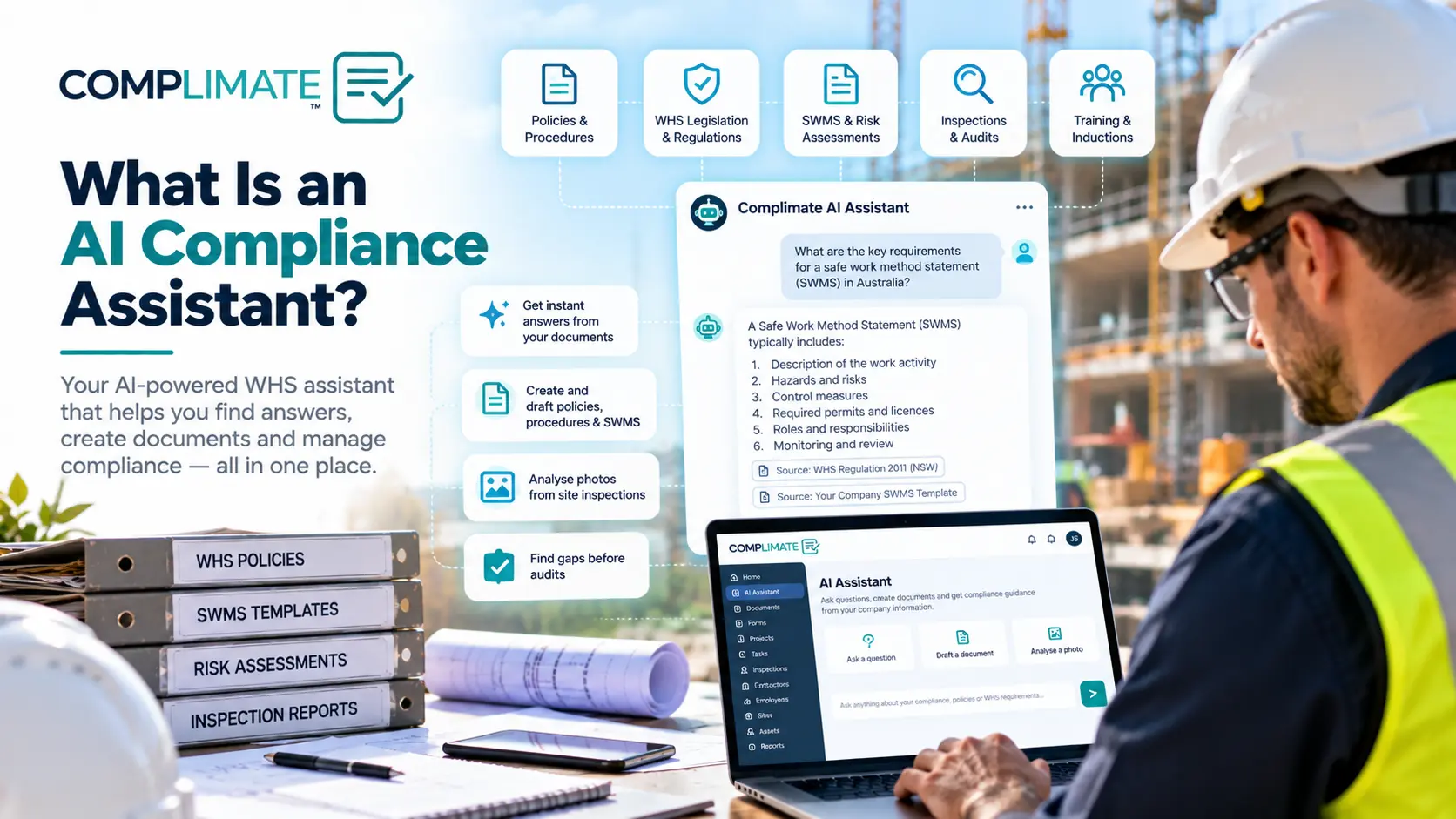
Work health and safety (WHS) compliance involves more than storing policies and completing checklists. Businesses must manage documents, understand their responsibilities, review risks, record incidents and follow up on corrective actions.
An AI compliance assistant is a software tool that uses artificial intelligence to help people find compliance information, understand documents and complete routine compliance tasks. For Australian businesses, it can help WHS and compliance teams access relevant information faster, while keeping people responsible for decisions and workplace safety.
How Does an AI Compliance Assistant Work?
An AI compliance assistant processes a user's question and uses available information to generate a relevant answer. Some tools rely on general AI knowledge, while others can search a company's uploaded documents and reference external regulatory information.
A document-based assistant can be particularly useful because it connects answers to the procedures and records a business actually uses.
A typical workflow involves:
Upload documents: Add relevant policies, procedures, safe work method statements (SWMS), risk assessments and compliance records.
Ask a question: For example, ask where to find the company's emergency response procedure.
Retrieve relevant information: The assistant searches the information available to it and generates a response.
Review the answer: A responsible person checks the source, context and accuracy.
Take action: The team updates a document, assigns a task or follows the appropriate workplace procedure.
The quality of the result depends on the information available, how current it is and how well the AI system identifies relevant sources.
Key Takeaways
An AI compliance assistant helps users find and understand compliance information using AI.
It can answer questions from uploaded policies, procedures and other business documents.
Depending on its features, it may help draft documents, review evidence and identify potential gaps.
AI-generated answers need human review, especially when they relate to legal duties or workplace risks.
It supports compliance management but does not replace competent people, professional advice or a business's WHS responsibilities.
What Can an AI Compliance Assistant Help With?
The exact capabilities depend on the software. Common uses include the following.
1. Finding Answers in Company Documents
Employees and supervisors may spend time searching shared drives for policies, procedures and registers. An AI assistant can help users find relevant information by asking questions in plain English.
For example, a supervisor could ask, "What is our process for reporting a workplace incident?" The assistant may retrieve relevant information from the company's uploaded incident reporting procedure.
This makes internal information easier to access, provided the relevant document is available and up to date.
2. Understanding WHS Requirements
An AI assistant may help users explore relevant workplace health and safety requirements and identify information that needs further review.
Australian WHS laws vary by jurisdiction. Safe Work Australia explains that model WHS laws have been implemented across most Australian jurisdictions, while Victoria has a different framework. Businesses should check the requirements that apply to their location and industry.
An AI-generated explanation should therefore be treated as a starting point for research, not a final legal interpretation.
3. Drafting Policies and Procedures
Some AI compliance tools can help prepare initial drafts of policies, procedures, checklists and other compliance documents.
These drafts can save time, but they must be reviewed and adapted to the business's actual activities, hazards, responsibilities and legal requirements before use.
4. Supporting Audits and Corrective Actions
AI-assisted audit tools may help organise evidence, identify potential gaps and connect findings with relevant requirements.
The next step is just as important: assigning responsibility, setting deadlines, recording evidence and checking that corrective actions have been completed.
AI can support this workflow, but a qualified or appropriately experienced person must assess the findings and decide what action is required.
Practical Example: Using AI to Support a WHS Audit
Imagine a construction business managing several sites. During an inspection, a supervisor finds that a required piece of equipment has an overdue inspection record.
A connected compliance workflow could look like this:
The supervisor records the finding and attaches a photo or supporting evidence.
The compliance team checks the relevant procedure, register and applicable requirements.
An AI assistant helps locate the relevant documents and identify questions that need investigation.
The team records the finding and assigns a corrective action to the responsible person.
The action owner completes the required work and uploads evidence.
The responsible manager reviews the evidence and closes the action when satisfied.
The benefit is not simply generating an AI answer. It is connecting information with a clear process for follow-up and accountability.
What Are the Benefits of an AI Compliance Assistant?
For Australian businesses, potential benefits include:
Faster information retrieval: Find relevant policies and records without searching multiple folders.
Less repetitive administration: Get help with first drafts and routine document-related tasks.
Better access to procedures: Help authorised employees locate the information they need.
More organised reviews: Identify potential gaps that require human investigation.
Clearer follow-up: When integrated with compliance workflows, connect findings to owners, deadlines and evidence.
These benefits depend on the tool's capabilities, the quality of the business's records and how consistently people use the system.
What Are the Risks and Limitations?
AI can produce inaccurate, incomplete or outdated answers. A confident response does not automatically mean it is correct.
Before relying on an AI compliance assistant, businesses should consider:
Accuracy: Can users inspect the documents or references supporting an answer?
Currency: Are the source documents and regulatory references up to date?
Jurisdiction: Does the answer reflect the laws applicable to the relevant Australian state or territory?
Privacy: How are uploaded documents stored, protected and accessed?
Human oversight: Is there a clear process for reviewing important answers and approving documents?
Accountability: Can the business assign, track and verify actions arising from an identified issue?
Safe Work Australia explains that WHS duties cannot simply be transferred to another person. Using AI software does not remove the responsibilities of a business or other duty holders.
For this reason, AI should support informed decisions rather than make unreviewed decisions about legal compliance or workplace safety.
What Should You Look for in AI Compliance Software?
Before choosing a tool, assess whether it fits your existing compliance processes.
The best choice is not necessarily the tool with the most AI features. Look for software that fits your business, supports your compliance workflow and makes information easier to verify and act on.
How Complimate Supports AI-Assisted Compliance
Complimate is a WHS and compliance management platform designed for Australian businesses. Its AI compliance assistant helps users find answers from uploaded business documents and explore relevant WHS legislation, standards and government requirements.
The platform also brings together supporting compliance workflows, including:
Document and policy management
AI-assisted policy and procedure drafting
Digital forms, inspections and audits
Corrective action tracking, with owners and due dates
Contractor, employee, site and asset records
Mobile access to compliance information and tasks
This connected approach helps teams move from finding information to managing the work that follows.
Explore Complimate's safety management software to learn more about its features and workflows.
Frequently Asked Questions
Is an AI compliance assistant the same as compliance management software?
No. An AI compliance assistant focuses on tasks such as answering questions, finding information and helping prepare documents. Compliance management software can cover a wider range of activities, including document control, audits, inspections, corrective actions and reporting. Some platforms combine both.
Can an AI compliance assistant guarantee WHS compliance?
No. AI software cannot guarantee that a business meets every applicable legal requirement. Results depend on the quality of its information, the accuracy of its outputs and the actions taken by the business. Human review remains essential.
Can AI review WHS documents?
Some AI tools can review uploaded documents, summarise their contents and flag potential gaps for further investigation. These findings should be checked against current requirements and the business's actual working conditions before action is taken.
Is an AI compliance assistant suitable for small businesses?
It can be useful for small businesses that need to organise documents, find procedures and manage recurring compliance tasks. The right solution should match the business's size, risks, budget and level of compliance complexity.
Does an AI compliance assistant replace a WHS manager or consultant?
No. It can support research, administration and document reviews, but it does not replace professional judgement, workplace consultation or the responsibilities of people who manage health and safety.
How do I choose an AI compliance assistant in Australia?
Look for reliable document-based answers, verifiable sources, current information, suitable access controls and a clear human review process. Check that the software supports your jurisdiction and integrates with the compliance activities your business needs to manage.
Final Thoughts
An AI compliance assistant can make compliance information easier to find and help teams handle routine document-related tasks. Its value increases when it works alongside practical processes for inspections, audits, corrective actions and record management.
For Australian businesses, the goal should be to use AI responsibly: make information accessible, verify important answers and ensure that identified issues are reviewed and addressed by the right people.
Want to simplify your WHS and compliance workflows? Explore Complimate's safety management software to see how AI-assisted information access can work alongside document management, audits and corrective action tracking.