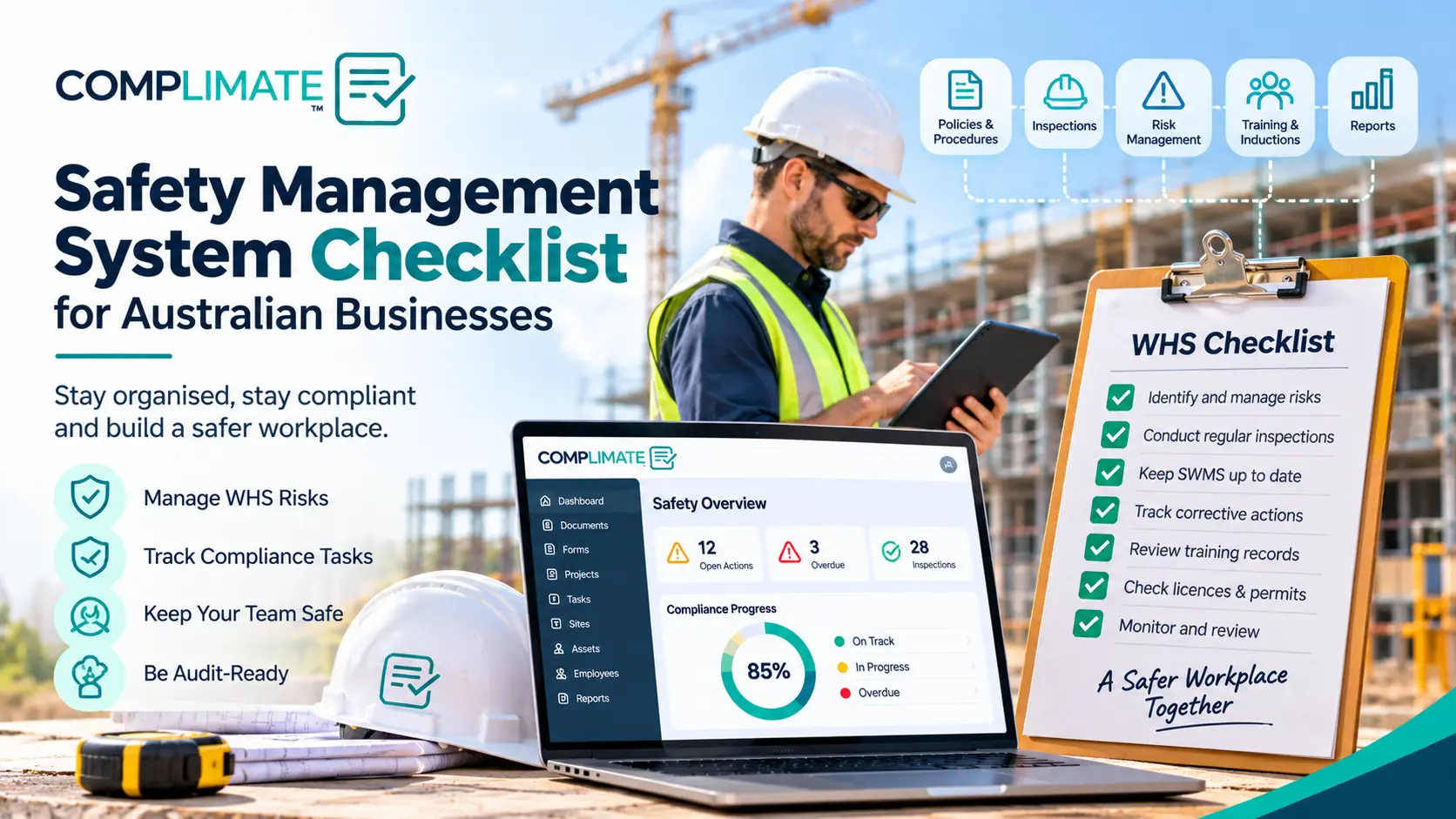
A safety management system (SMS) helps a business identify workplace hazards, manage risks, assign safety responsibilities and monitor work health and safety (WHS) performance.
For Australian businesses, having policies and procedures is only one part of the process. A practical system should also cover worker consultation, risk assessments, training, incident reporting, inspections, corrective actions and regular reviews.
This safety management system checklist provides a practical starting point for reviewing your existing WHS processes and identifying areas that may need attention.
What Should a Safety Management System Include?
A workplace safety management system should connect the main activities involved in managing health and safety. These generally include:
WHS policies and responsibilities
Hazard identification and risk assessments
Risk control procedures
Worker consultation and communication
Training and competency records
Incident and near-miss reporting
Workplace inspections and audits
Emergency procedures
Contractor and visitor management
Corrective actions and continuous improvement
The system should reflect your business activities, workplace risks, workforce and applicable legal requirements.
Safety Management System Checklist
Use the following checklist to review the main areas of your WHS management system.
1. WHS Policies and Responsibilities
Your business should have clear safety policies and documented responsibilities.
A current WHS policy is available.
Management and supervisor responsibilities are documented.
Workers understand their WHS responsibilities.
WHS procedures are available and accessible.
Policies and procedures are reviewed when required.
Relevant documents have clear version and review dates.
A policy should explain the organisation's commitment to workplace safety. Procedures should explain how specific safety activities are carried out.
For help understanding your broader obligations, read our guide to WHS compliance software.
2. Hazard Identification and Risk Management
Identifying hazards and managing risks should be an ongoing activity, not something done only before an audit.
Workplace hazards are identified.
Risk assessments are completed for relevant activities.
Risk controls are documented.
Controls follow the hierarchy of control where applicable.
Workers are consulted about hazards and controls.
Controls are monitored to check whether they remain effective.
Risk assessments are reviewed when work conditions change.
For construction businesses, this may also include reviewing SWMS and PCBU compliance requirements.
3. Worker Training and Inductions
Workers need appropriate information, instruction, training and supervision to perform their work safely.
New workers complete workplace inductions.
Site-specific inductions are provided where needed.
Training records are maintained.
Required licences and qualifications are checked.
Refresher training is scheduled where appropriate.
Supervisors understand their safety responsibilities.
Workers can access relevant safety procedures.
A training record should show what training was completed, who completed it and when. Keep track of qualifications and expiry dates where relevant.
4. Incident and Near-Miss Management
A good safety management system needs a clear process for reporting, investigating and responding to incidents.
Workers know how to report incidents and near misses.
Incident reports are recorded.
Incidents are investigated where appropriate.
Contributing factors are identified.
Corrective actions are assigned to responsible people.
Actions have due dates and completion records.
Notifiable incidents are reported to the relevant regulator as required.
A documented process helps businesses learn from incidents and address underlying risks.
See how incident management software can help organise reports, investigations and follow-up actions.
5. Workplace Inspections and Safety Audits
Regular inspections and audits help businesses check whether safety procedures are being followed and controls are working.
Workplace inspections are scheduled.
Inspection checklists cover relevant hazards.
Findings are documented.
Photos or other evidence are retained where useful.
Audit findings are assigned for follow-up.
Corrective actions are tracked to completion.
Audit records are available for review.
Explore WHS compliance and audit software to understand how digital audit workflows can support this process.
6. Emergency Preparedness
Every workplace should have emergency arrangements suited to its activities and risks.
An emergency plan is documented and maintained.
Evacuation procedures are communicated.
Emergency contacts and responsibilities are clear.
First aid arrangements are suitable.
Workers receive relevant emergency training.
Emergency procedures are tested.
Plans are reviewed after relevant workplace changes or testing.
7. Contractor and Visitor Management
Businesses that engage contractors or share workplaces with other businesses should have processes for coordinating safety responsibilities.
Contractor WHS requirements are defined.
Relevant licences and qualifications are checked.
Contractor inductions are completed.
Relevant SWMS and risk documents are reviewed.
Site access and supervision arrangements are clear.
Safety responsibilities are coordinated with other duty holders.
Contractor records are maintained.
Our contractor management software page explains how digital processes can help organise contractor information and compliance records.
8. Equipment, Documents and Records
Your business should be able to find important safety information when it is needed.
Plant and equipment are recorded in a register where appropriate.
Inspection and maintenance schedules are maintained.
Relevant licences, certificates and service records are available.
WHS documents are stored in an organised location.
Document versions and review dates are controlled.
Expired or outdated documents are identified.
Safety records can be retrieved for audits and reviews.
A central document management system can help organise policies, procedures, registers and other compliance records. Businesses managing plant and equipment can also explore plant and equipment register software.
How Often Should You Review a Safety Management System?
There is no single review schedule that suits every business. Reviews should reflect the nature of the work, the risks involved and applicable legal requirements.
Consider reviewing your system:
When work activities, equipment or processes change.
When new hazards are identified.
After incidents or near misses.
When inspections or audits identify gaps.
When new legal or regulatory requirements affect your business.
When existing risk controls may no longer be effective.
At planned intervals set by your organisation.
The purpose is to check whether the system remains suitable, current and effective.
How Can Safety Management Software Help?
Many businesses manage WHS information across spreadsheets, paper forms, shared drives and separate registers. This can make it difficult to track responsibilities, find current documents and follow up on outstanding actions.
Safety management software can bring these activities into a connected workflow.
For example, a workplace inspection may identify a hazard. The finding can then be recorded, assigned to a responsible person, given a due date and tracked until the corrective action is completed.
Complimate helps Australian businesses manage safety documents, digital forms, audits, incidents, corrective actions, contractors and other compliance workflows in one platform.
Explore Complimate's safety management software to see how these processes can be organised digitally.
Frequently Asked Questions
1. Is a safety management system mandatory in Australia?
WHS laws impose duties on businesses and other duty holders to manage health and safety risks. A formal document called a safety management system may not be required for every business, but businesses need effective arrangements to meet their applicable duties.
Requirements can vary by jurisdiction and industry.
2. What are the five main elements of a safety management system?
A practical system commonly covers:
WHS policies and responsibilities.
Hazard identification and risk management.
Worker training and consultation.
Incident reporting and corrective actions.
Monitoring, audits and continuous improvement.
Other elements, such as contractor management, emergency planning and equipment maintenance, should also be included where relevant.
3. How do small businesses manage WHS compliance?
Small businesses can start by identifying their main workplace hazards, documenting suitable risk controls, consulting workers, providing relevant training and maintaining essential safety records. The system should be proportionate to the nature and risks of the work.
4. What is the difference between a safety management system and safety management software?
A safety management system is the set of policies, procedures, responsibilities and processes a business uses to manage workplace safety. Safety management software is a digital tool that can help organise and manage those processes.
Software supports the system; it does not replace management responsibility or worker participation.
5. Can a safety management system checklist guarantee WHS compliance?
No. A checklist is a review tool, not a guarantee of compliance. Businesses must consider their actual work activities, risks and applicable WHS or OHS laws. They may also need industry-specific procedures and advice.
Build a More Organised Safety Management System
A practical safety management system should do more than store policies and completed checklists. It should help your business identify risks, assign responsibilities, maintain records and follow corrective actions through to completion.
Start by reviewing the checklist above, identifying gaps and assigning responsibility for each improvement.
If your business wants to bring safety documents, audits, digital forms and corrective actions into one connected workflow, explore Complimate's safety management software.
Review your current WHS processes and see where a more organised approach can make everyday safety management easier.