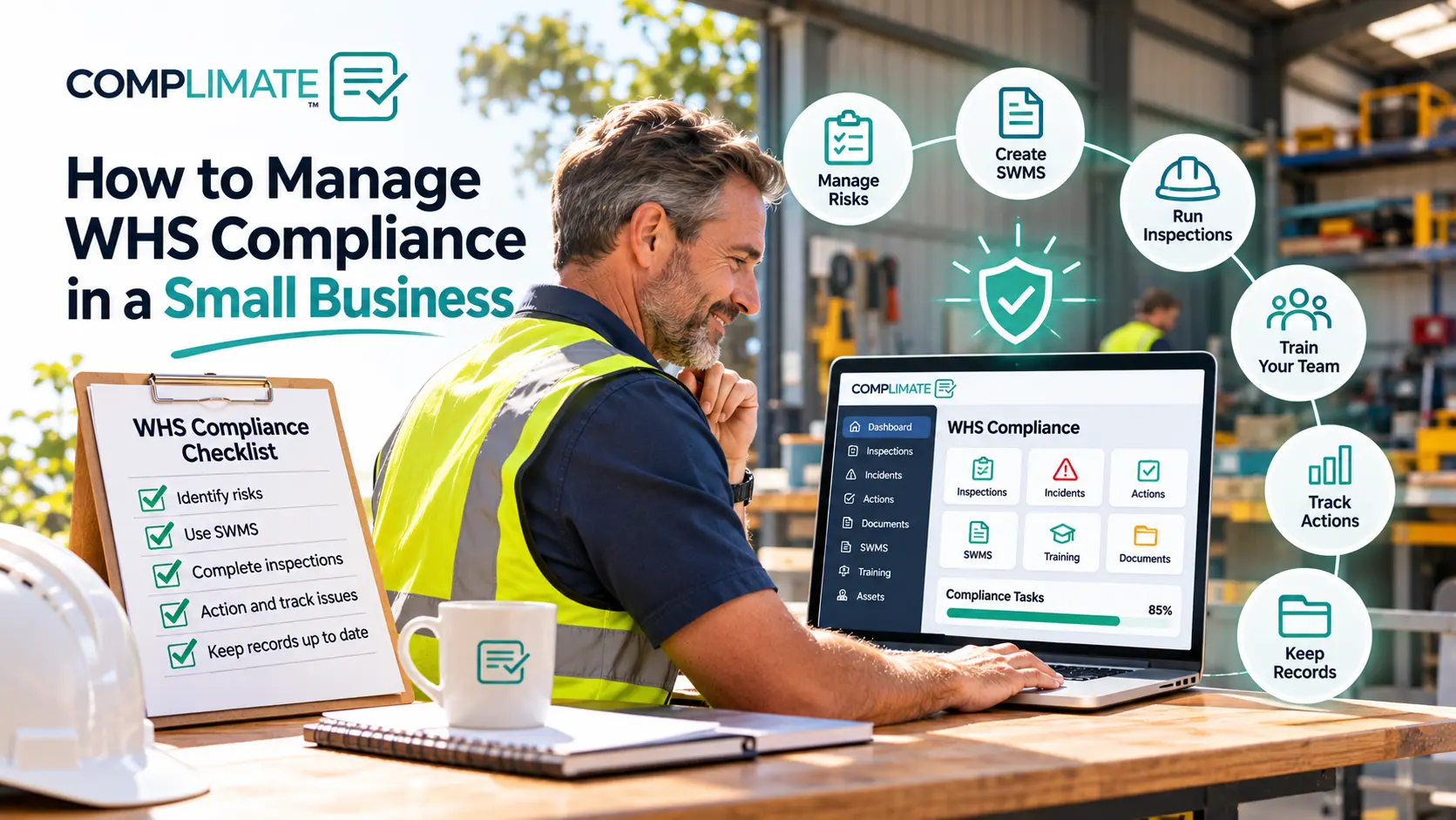
Managing work health and safety (WHS) can feel challenging when you run a small business. You may not have a dedicated safety manager, a large administration team or the budget for complex systems. At the same time, you still need to identify workplace hazards, manage risks, consult workers and keep appropriate safety records.
The good news is that WHS management does not have to be complicated. A practical system built around your actual work activities can help you manage safety responsibilities without creating unnecessary paperwork.
To manage WHS compliance in a small business, understand your legal duties, identify workplace hazards, control risks, consult workers, provide suitable training, record incidents and review safety procedures regularly. The process should be ongoing and reflect the size, nature and risks of your business.
WHS Compliance Checklist for Small Businesses
Use this checklist as a starting point for reviewing your current WHS arrangements.
Identify the WHS laws and requirements relevant to your business.
Understand your responsibilities as a PCBU.
Identify workplace hazards and assess risks.
Implement suitable risk controls.
Consult workers about safety matters.
Maintain relevant WHS policies and procedures.
Provide appropriate training and inductions.
Schedule workplace inspections.
Record hazards, incidents and near misses.
Assign and track corrective actions.
Maintain relevant training, equipment and safety records.
Review WHS arrangements regularly.
This is a general checklist, not a complete list of every legal requirement. Your obligations depend on your industry, activities, risks and jurisdiction.
Key Takeaways
WHS responsibilities apply to small businesses, not just large organisations.
Start by identifying the hazards and risks associated with your actual work.
Consult workers when making health and safety decisions.
Keep relevant records of training, inspections, incidents and corrective actions.
Review safety controls when work conditions, equipment or processes change.
Use digital tools to organise documents, inspections and follow-up tasks as your business grows.
1. Understand Your WHS Responsibilities
The first step is understanding which work health and safety requirements apply to your business.
Under Australian WHS laws, a person conducting a business or undertaking (PCBU) has a primary duty to ensure, so far as is reasonably practicable, the health and safety of workers and other people who may be affected by the business.
This responsibility can apply whether you operate a construction company, retail store, professional service, workshop or childcare business.
Your responsibilities may include:
Providing and maintaining a safe work environment.
Providing and maintaining safe equipment and systems of work.
Ensuring workers receive appropriate information, training and supervision.
Monitoring workplace conditions and worker health where required.
Identifying hazards and managing workplace risks.
Consulting workers about health and safety matters.
WHS laws are based on a national model framework, but adoption and requirements can vary between Australian states and territories. Check the legislation and guidance that apply in your jurisdiction.
For more information, read the official Safe Work Australia guidance on WHS duties.
2. Identify Workplace Hazards and Assess Risks
You cannot manage workplace risks if you do not know what they are.
Walk through your workplace and review the tasks employees, contractors and other workers perform. Consider both routine activities and less frequent jobs.
Common workplace hazards include:
Slippery floors and obstructed walkways.
Manual handling and repetitive movements.
Faulty machinery, tools or electrical equipment.
Hazardous chemicals and substances.
Working at heights.
Vehicle and plant movement.
Workplace stress, bullying and other psychosocial hazards.
Use a simple risk management process:
Identify hazards: Find anything that could cause injury or illness.
Assess risks: Consider how someone could be harmed and how serious the outcome could be.
Control risks: Eliminate the hazard where reasonably practicable. If that is not possible, minimise the risk using suitable controls.
Review controls: Check whether the controls are working and update them when necessary.
For example, if employees regularly lift heavy items, consider whether the task can be redesigned, mechanical lifting equipment introduced or loads reduced.
The aim is to control the risk at its source rather than relying only on warnings or personal protective equipment.
3. Create Practical WHS Policies and Procedures
Small businesses do not need a large collection of documents that nobody reads. They need clear procedures that explain how important safety activities are managed.
Depending on your business and its risks, useful WHS documents may include:
Work health and safety policy.
Emergency response and evacuation procedures.
Hazard and incident reporting procedures.
Risk assessments and safe work procedures.
Worker consultation arrangements.
Training and induction records.
Inspection and maintenance procedures.
Relevant Safe Work Method Statements (SWMS).
Make sure documents reflect how work is actually performed. Review them when there are changes to tasks, equipment, workplace conditions or applicable requirements.
A central document management system can help keep policies, procedures and risk assessments organised. Complimate's document management capabilities are designed to help businesses centralise WHS documents, manage versions and monitor review or expiry dates.
4. Consult Workers About Workplace Safety
Worker consultation is an important part of managing WHS.
Employees often understand the practical risks involved in their daily tasks. They may notice problems that are not obvious during a management inspection.
Consult workers when:
Identifying hazards and assessing risks.
Deciding how to eliminate or minimise risks.
Introducing changes that may affect workplace safety.
Reviewing safety procedures.
Making decisions about workplace facilities.
Consultation does not always require formal meetings. Depending on your workplace, it could involve toolbox talks, team discussions, pre-start meetings or a health and safety committee.
Make sure workers have a genuine opportunity to raise concerns and that relevant feedback is considered.
5. Provide Appropriate WHS Training and Inductions
Workers need to understand the risks associated with their roles and how to work safely.
Your training arrangements should reflect the work being performed, the worker's experience and any specific legal or industry requirements.
A small business may need to organise:
Workplace health and safety inductions.
Emergency and evacuation training.
Safe equipment and machinery operation.
Manual handling training.
Hazard and incident reporting instructions.
Task-specific training and supervision.
Contractor and visitor inductions where relevant.
Keep records of completed training, relevant qualifications and licences where required. Set up a process to review records before important documents or licences expire.
6. Conduct Regular Inspections and Report Incidents
A WHS system should not exist only in documents. You need to check whether safety controls are being followed in the workplace.
Schedule inspections based on your business activities and the level of risk. An inspection may cover:
Equipment condition and maintenance.
Housekeeping and access ways.
Electrical safety.
Emergency equipment.
Personal protective equipment.
Hazardous substances.
Site-specific safety controls.
When a hazard or incident is identified, record what happened and decide what action is needed.
A useful incident or hazard record should capture:
Date, time and location.
Description of the hazard or incident.
People involved, where appropriate.
Immediate actions taken.
Investigation findings, where relevant.
Corrective actions and assigned responsibilities.
Action completion and verification.
Certain incidents must be notified to the relevant regulator. Check the notification requirements that apply to your jurisdiction and circumstances.
Most importantly, do not stop at recording an issue. Follow it through until the required corrective action has been completed and checked.
7. Keep WHS Records Organised
Keeping appropriate WHS records helps you understand what has been done, identify outstanding work and review whether your controls are effective.
Depending on your business, records may include:
Record-keeping requirements and retention periods can differ depending on the type of record and the applicable WHS laws.
The level of detail should reflect your workplace and the risks involved. Safe Work Australia's Code of Practice: How to Manage Work Health and Safety Risks explains how risk management records can support ongoing reviews and demonstrate the steps taken.
8. Use WHS Software to Simplify Compliance Management
Spreadsheets, paper forms and shared folders may be enough when a business is small. However, as your team, sites, contractors and safety activities grow, information can become difficult to manage.
You might find that:
Inspection records are stored in different locations.
Important documents are out of date.
Corrective actions are not followed up.
Training records are difficult to locate.
Managers cannot easily see which safety tasks are overdue.
WHS compliance software can help bring these activities into one organised system.
For example, a platform such as Complimate supports businesses with:
Digital WHS forms and inspections: Create and manage digital forms and collect workplace information.
Hazard and incident management: Record workplace issues and maintain relevant records.
Corrective action tracking: Assign actions, responsibilities and due dates.
Document management: Organise policies, procedures, SWMS and other compliance documents.
Task management: Keep important safety activities visible and track their progress.
Registers and assets: Maintain relevant site, plant and equipment information.
The benefit is not simply moving paperwork online. It is connecting safety activities so that an inspection finding can lead to a corrective action, an assigned task and a documented outcome.
Software supports the process, but it does not replace management responsibility, worker consultation, professional advice or effective workplace controls.
9. Review and Improve Your WHS System
WHS management is not a one-time exercise. Your safety arrangements should change as your business changes.
Review your system when:
A workplace incident or near miss occurs.
An inspection identifies a problem.
New equipment or work processes are introduced.
Your workplace or workforce changes.
A safety control is not working as expected.
Relevant legislation or guidance changes.
You should also schedule periodic reviews of your policies, risk assessments, training records and inspection processes.
Ask practical questions:
Are our main workplace hazards identified?
Are our controls effective?
Do workers understand their responsibilities?
Are outstanding corrective actions being completed?
Are our documents current?
Can we find the records we need?
A simple system that is regularly used and improved is more useful than a large collection of documents that is rarely reviewed.
Frequently Asked Questions
1. Do small businesses need to follow WHS laws in Australia?
Yes. Small businesses have WHS responsibilities under the laws applicable to their operations. The level of risk management and documentation should reflect the nature of the work, but business size does not remove WHS duties.
2. What is the easiest way to manage WHS compliance in a small business?
Start by identifying your main workplace hazards, implementing suitable controls, consulting workers and keeping relevant records. Assign responsibility for important safety tasks and review them regularly.
3. What WHS documents should a small business maintain?
Depending on its activities and legal requirements, a business may need WHS policies, risk assessments, SWMS, training records, inspection checklists, incident reports, emergency procedures and equipment records.
4. How often should a small business review its WHS procedures?
Review procedures regularly and whenever something changes that may affect safety. This includes incidents, new equipment, changes to work processes, inspection findings and relevant legislative updates. The appropriate review frequency depends on the risks and circumstances.
5. Can WHS software help a small business manage compliance?
Yes. WHS software can help organise documents, digital forms, inspections, incidents, corrective actions and tasks. It can make records easier to access and follow-up activities easier to track, but it does not guarantee compliance or replace effective safety management.
6. Is a WHS management system compulsory for every small business?
There is no single answer that applies to every business. WHS duties apply, but the specific systems, procedures and records needed depend on the business's activities, risks and applicable legislation. A practical WHS management system can help organise how those responsibilities are managed.
Final Thoughts
Managing WHS compliance in a small business starts with understanding your responsibilities and managing the risks associated with your work. You do not need to create unnecessary paperwork or copy a large organisation's safety system.
Focus on practical steps: identify hazards, consult workers, provide training, maintain useful records, complete corrective actions and review your controls.
As your business grows, digital tools can make these processes easier to organise and monitor.
Looking for a simpler way to manage workplace safety and compliance? Explore Complimate to see how digital forms, inspections, document management and corrective action tracking can support your WHS processes.