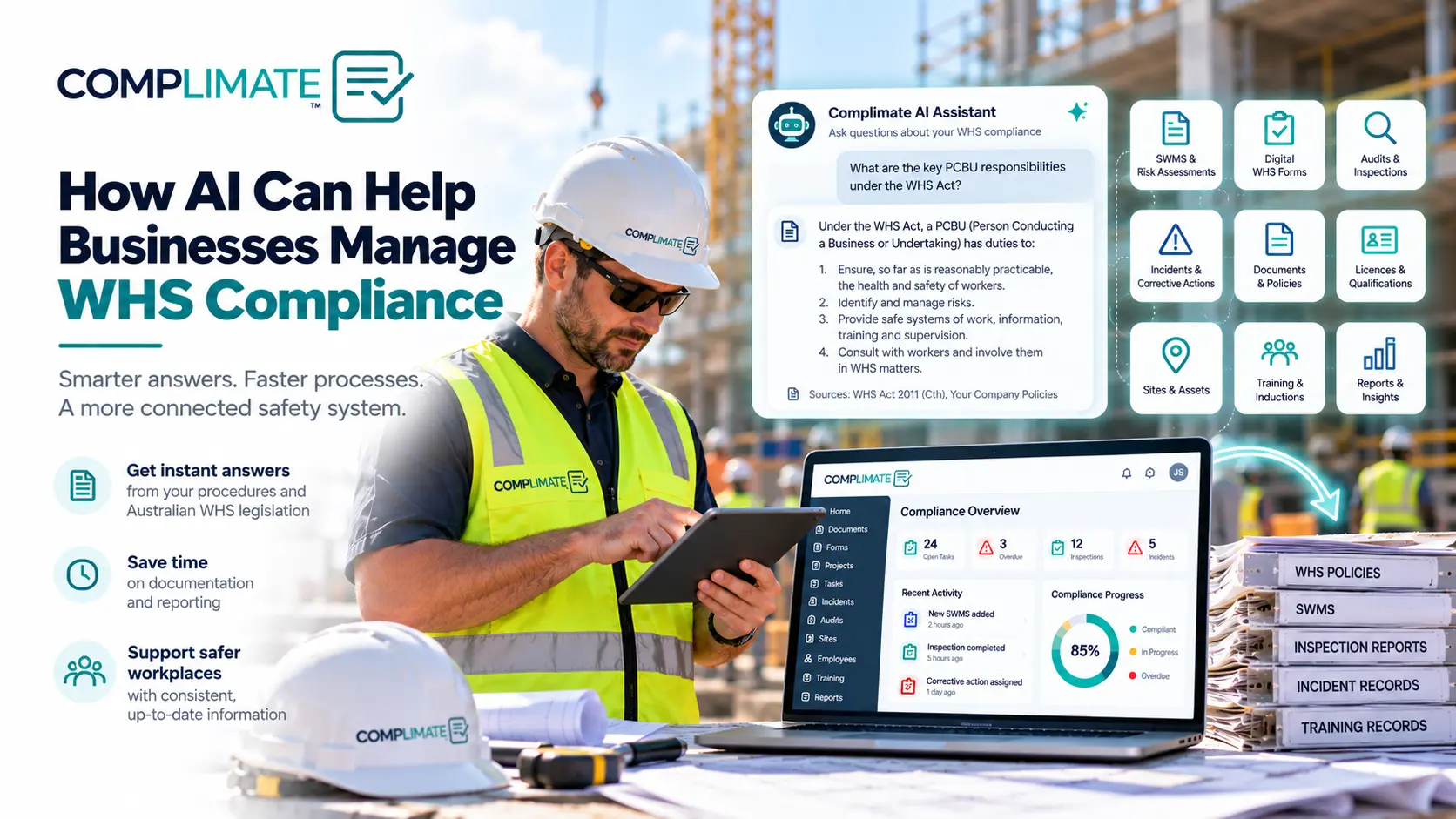
Managing work health and safety (WHS) compliance can be challenging for Australian businesses. Policies, Safe Work Method Statements (SWMS), inspection records, training documents and corrective actions often sit across different systems. Finding the right information and keeping records up to date can take valuable time.
Artificial intelligence (AI) can help simplify these tasks. It can search documents, support policy drafting, assist with compliance reviews and help teams organise follow-up actions.
However, AI does not replace WHS professionals or remove a business’s legal responsibilities. Its value comes from helping people find information, manage records and make better-informed decisions.
Key Takeaways
AI can help teams find information in WHS documents faster.
It can support policy drafting, document reviews and audit preparation.
AI-powered tools can help identify potential gaps and organise corrective actions.
Human review remains essential for safety decisions and legal interpretation.
The right WHS compliance software connects documents, audits, tasks and evidence.
1. How Can AI Help Manage WHS Compliance?
AI can support several parts of a business’s WHS management process, including:
Document management: Find policies, procedures, risk assessments and other records.
Policy drafting: Create draft policies and procedures for review.
Compliance reviews: Highlight potential gaps or missing information in documents.
Audit preparation: Help organise evidence and summarise findings.
Corrective actions: Help teams record issues, assign responsibilities and track progress.
Information access: Answer questions using approved company documents and relevant reference material.
For example, a site supervisor may need to check a company’s procedure for reporting a workplace hazard. Instead of searching through several folders, an AI compliance assistant may retrieve the relevant information from uploaded documents.
This can save time, but the supervisor should still check that the answer is current and appropriate for the situation.
2. Using AI to Review WHS Documents
Businesses often manage many documents, including WHS policies, procedures, SWMS, risk assessments, inspection records and emergency plans.
AI can help review these documents for potential issues, such as missing sections, inconsistent information or details that may need updating.
For example, an AI tool could help a WHS manager:
Review a draft safety procedure.
Compare a document with selected requirements.
Identify missing information for further investigation.
Summarise key points from lengthy documents.
Prepare a draft for review by a qualified person.
These checks can support a more organised review process. They should not be treated as proof that a document meets every applicable legal requirement.
Businesses should also maintain version control and review documents when work activities, equipment, risks or relevant requirements change.
3. How AI Can Support WHS Audits
WHS audits help businesses assess their safety processes, records and controls. Preparing for an audit can involve collecting evidence, reviewing documents and following up on findings.
AI can assist by organising information, summarising documents and highlighting areas that may need closer attention.
A practical workflow could look like this:
Upload relevant policies, procedures and compliance records.
Review the information against the selected audit criteria.
Investigate potential gaps identified by the tool.
Record confirmed findings and supporting evidence.
Assign corrective actions to responsible team members.
Review progress and document closure.
The auditor or responsible WHS professional must verify findings and decide what action is appropriate. AI should support the audit process, not make the final compliance decision.
4. Tracking Corrective Actions and Compliance Tasks
Identifying a problem is only one part of managing WHS. Businesses also need to make sure that corrective actions are assigned, completed and checked.
For example, an inspection may identify damaged equipment. The issue needs to be recorded, responsibility assigned, an appropriate deadline set and evidence of the completed action retained.
When AI-supported reviews are connected to a compliance management system, teams can spend less time organising information and more time addressing outstanding issues.
Look for software that supports:
Assigned task owners and due dates.
Evidence and comments linked to findings.
Overdue action tracking.
Document and licence expiry reminders.
Reports showing open and completed actions.
These features help create a clearer record of how issues are managed. They do not guarantee that every risk will be identified or that every action will be completed correctly.
5. What Should Businesses Look for in AI WHS Software?
Not every AI tool is designed for workplace safety and compliance. Businesses should assess how a tool handles their documents, evidence, workflows and data.
Consider these questions before choosing a platform:
Can it answer questions using our own approved documents?
Does it show sources or references that users can verify?
Can it help review policies, procedures and SWMS?
Can audit findings be connected to corrective actions?
Can we track document versions, expiry dates and responsibilities?
Are access controls and data security suitable for our organisation?
Can people review and correct AI-generated information?
For Australian businesses, it is also important to check the relevant state or territory requirements. Safe Work Australia explains that model WHS laws are not implemented identically in every jurisdiction.
Read the official guidance on duties under WHS laws and check the requirements that apply to your business.
6. How Complimate Helps Businesses Manage WHS Compliance
Complimate brings compliance documents, AI-assisted support, audits and corrective actions into one platform.
Its features are designed to help Australian businesses organise their compliance work, including:
AI Compliance Assistant: Ask questions and retrieve answers from uploaded company documents.
Document management: Keep policies, procedures, registers and other records organised, with version and expiry tracking.
AI-assisted audits: Review information, identify potential issues and organise supporting evidence.
Corrective Action Register: Assign responsibilities, set due dates and track actions through to closure.
Compliance tasks and alerts: Monitor deadlines, training and document renewals.
Explore Complimate’s WHS and safety management software to learn how these workflows can support day-to-day compliance management.
AI can make compliance information easier to access and help reduce repetitive administrative work. The best results come when technology supports a clear process, competent people and regular reviews.
Frequently Asked Questions
Can AI manage WHS compliance automatically?
AI can support document reviews, information retrieval, audit preparation and task management. However, businesses still need people to verify information, assess risks and fulfil their legal duties.
Can AI check whether a WHS policy complies with Australian law?
AI can help compare a policy with selected legal or organisational requirements and highlight potential gaps. A qualified person should verify the findings against current requirements and the circumstances of the workplace.
Can AI help prepare for a WHS audit?
Yes. It can help organise records, summarise documents and identify areas that may need review. Audit findings and compliance decisions still require appropriate human assessment.
Is AI suitable for small businesses?
AI-supported compliance software may help small businesses organise documents, find information and track tasks without relying on scattered files and spreadsheets. The right solution depends on the business’s risks, size and needs.
What is the difference between AI compliance software and traditional WHS software?
Traditional WHS software often focuses on recording forms, incidents, inspections and tasks. AI-enabled compliance software can add capabilities such as document-based question answering, draft generation and assistance with reviews. Actual features vary between platforms.
Conclusion
AI can help Australian businesses manage WHS compliance by making documents easier to search, supporting policy reviews, organising audit evidence and helping teams follow up on corrective actions.
However, AI should be used as a support tool rather than the final authority on workplace safety or legal compliance. Businesses still need accurate records, suitable risk controls, regular reviews and people who understand their responsibilities.
If your business wants to bring documents, audits and corrective actions together, explore Complimate’s safety management software to see how a connected compliance workflow may fit your needs.