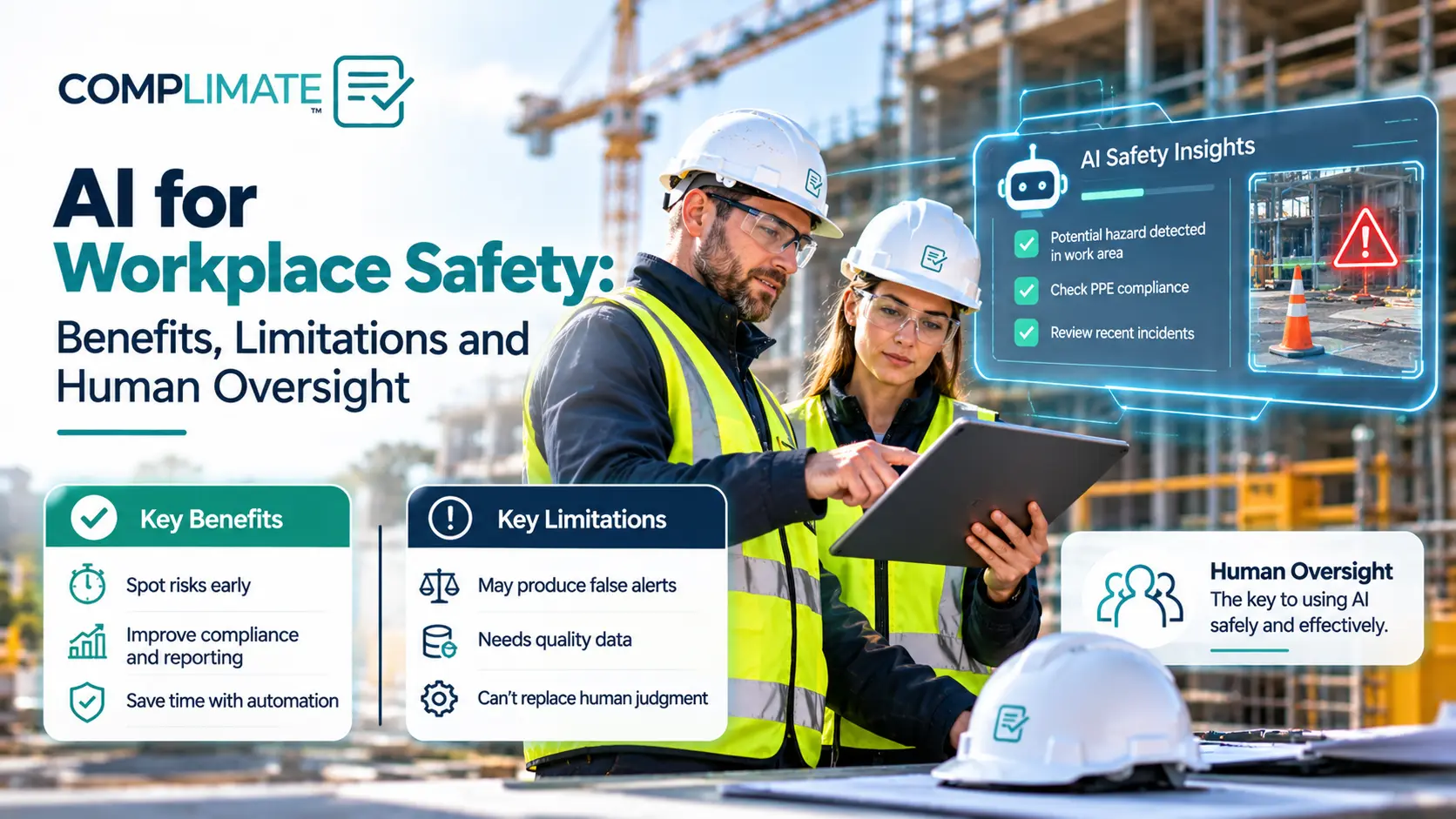
Artificial intelligence (AI) is changing how Australian businesses manage workplace health and safety (WHS). From reviewing safety documents to identifying potential hazards and organising compliance records, AI tools can help safety teams manage information and make better-informed decisions.
However, AI is not a replacement for workplace inspections, worker consultation or professional safety judgement. It can produce incorrect information, overlook important details or misunderstand a workplace situation.
The most effective approach is to use AI as a support tool while keeping people responsible for safety decisions.
Key Takeaways
AI can help identify patterns, review documents and organise WHS information.
AI tools can support incident reporting, risk assessments and compliance administration.
AI-generated recommendations may be incomplete, inaccurate or based on missing information.
Businesses must assess the WHS risks associated with introducing and using AI.
Human oversight, worker consultation and regular system reviews remain essential.
What Is AI for Workplace Safety?
AI for workplace safety refers to the use of artificial intelligence technologies to support activities such as hazard identification, risk assessment, incident analysis, safety documentation and compliance management.
For example, an AI tool may review an uploaded safety procedure and help identify missing information. Another tool may analyse incident records to highlight recurring types of workplace events.
AI can also help workers find relevant information in company policies and procedures without manually searching through multiple documents.
These tools can support WHS teams, but their outputs still need to be checked against actual workplace conditions, current requirements and professional advice.
Benefits of Using AI in Workplace Safety
When implemented appropriately, AI can help businesses improve how they manage safety information and administrative tasks.
1. Faster Access to WHS Information
Safety teams often work with large collections of policies, procedures, Safe Work Method Statements (SWMS), registers and inspection records.
AI-powered assistants can help users search these documents and find relevant information more quickly.
For example, a supervisor could ask:
"What is our procedure for reporting a workplace hazard?"
An AI assistant connected to the company's approved documents may help locate the relevant procedure and summarise its key steps.
The response should still be checked against the original document.
2. Support for Hazard Identification
AI tools can help review workplace photographs, inspection notes and incident records to identify potential safety concerns.
For example, an AI image analysis tool may flag a possible obstruction in a walkway or identify an issue that requires further inspection.
However, a photograph may not show the full workplace environment. Lighting, camera angles, missing context and hidden hazards can affect the result.
A competent person should inspect the situation before deciding what action is required.
3. Better Safety Document Management
Managing WHS documentation can become difficult when records are spread across spreadsheets, shared drives and paper files.
AI-supported document tools can help teams search, review and organise information.
Combined with document management software, businesses can also maintain document versions, review dates and expiry information.
This can make it easier to locate current policies, procedures, SWMS and other compliance records.
4. Improved Incident and Trend Analysis
AI can help analyse historical incident reports, hazard records and inspection findings.
For example, a business may use data analysis to identify:
Repeated incidents in a particular work area.
Common hazards reported across multiple sites.
Recurring equipment-related issues.
Corrective actions that remain overdue.
Patterns in near-miss reports.
These findings can help WHS teams decide where further investigation may be useful.
However, patterns in historical data do not automatically explain why an incident occurred or predict that another incident will happen.
5. Support for WHS Administration
AI can assist with repetitive administrative activities, including summarising documents, preparing draft procedures and organising compliance information.
This may give safety professionals more time to focus on workplace inspections, worker consultation, risk controls and follow-up activities.
AI should support these responsibilities, not remove the need for them.
Limitations and Risks of AI in Workplace Safety
AI offers useful capabilities, but businesses should understand its limitations before relying on it.
1. AI Can Provide Incorrect Information
Generative AI can produce answers that sound confident but contain errors or misleading information.
For example, an AI tool may refer to an outdated procedure, misunderstand a WHS requirement or suggest a control measure that is unsuitable for a particular workplace.
Always verify important outputs against current legislation, approved company documents and competent professional advice.
2. AI May Miss Workplace Context
A photograph or written report cannot always explain the complete situation.
An image of a worker using equipment may not show the equipment's condition, the surrounding hazards, the worker's training or the actual task being performed.
AI can highlight possible issues, but it cannot automatically understand every workplace condition.
3. Privacy and Data Security Concerns
Workplace safety records may contain personal information, injury details, photographs, employee records and confidential business documents.
Before using an AI tool, businesses should understand:
What information is collected and processed.
Where information is stored.
Who can access uploaded records.
Whether information is used to train external AI models.
How information is protected and retained.
Avoid uploading sensitive workplace or employee information into tools that have not been approved by the business.
4. Over-Reliance on Automated Recommendations
A business may become too dependent on AI-generated recommendations if employees assume that every answer is correct.
This can create problems when AI misses a hazard, misunderstands a risk or recommends an unsuitable control.
AI recommendations should be treated as information for review, not automatic instructions.
5. New Risks From Introducing Technology
AI and digital systems can also create new workplace risks.
For example, poorly designed monitoring systems may increase work pressure, reduce worker control or contribute to fatigue. Workers may also face additional demands if technology changes their roles without adequate training.
Safe Work Australia highlights that AI and digital technologies can introduce both physical and psychosocial risks.
Why Human Oversight Is Essential
Human oversight ensures that workplace safety decisions consider real conditions, worker experience and the responsibilities of the business.
Under Australian WHS laws, PCBUs must manage risks arising from the use of AI and digital technologies, just as they manage other workplace risks. They must also consult workers where required and provide suitable information, training, instruction and supervision.
Human oversight should include the following practices:
Verify AI-Generated Information
Check AI-generated risk assessments, procedures, audit findings and recommendations before approving or implementing them.
Involve Competent Safety Professionals
WHS managers, safety officers and other competent people should review recommendations that could affect worker health and safety.
Consult Workers
Workers often understand the practical conditions and challenges involved in their tasks. Their feedback can help identify risks that an AI system may overlook.
Keep Clear Accountability
Assign responsibility for reviewing AI outputs, approving documents, implementing control measures and monitoring results.
Monitor and Review AI Systems
Review how AI tools perform over time. Reassess risks when the technology changes, new problems emerge or existing controls are no longer effective.
How Australian Businesses Can Introduce AI Safely
Businesses should take a structured approach before introducing AI into workplace safety processes.
Identify the purpose: Decide which task AI will support, such as document review, incident analysis or information retrieval.
Assess potential risks: Consider accuracy, privacy, cybersecurity, worker impacts and the consequences of incorrect outputs.
Consult affected workers: Explain how the technology will be used and invite feedback before implementation.
Set clear responsibilities: Decide who can use the system, review its outputs and approve safety-related decisions.
Test before relying on it: Check the tool using realistic examples and verify its outputs against trusted information.
Train employees: Explain what the system can and cannot do, including when to seek human assistance.
Monitor performance: Record problems, review results and update controls when necessary.
The level of oversight should reflect the potential consequences of an incorrect AI output. Higher-risk safety decisions require stronger human review.
How WHS Software Can Support AI-Assisted Safety Management
AI works best when it supports a structured workplace safety management process.
A WHS platform can help businesses bring together safety documents, digital forms, inspections, incidents, corrective actions and compliance records.
For example, a hazard identified during an inspection can be recorded, assigned to a responsible person and followed through as a corrective action. The business can then maintain a record of the action and its progress.
Complimate brings together practical WHS and compliance workflows, with AI-assisted capabilities to support document review and access to company compliance information.
Its capabilities include:
AI Compliance Assistant: Helps users find information from company documents and review relevant compliance questions.
Document Management: Centralises policies, procedures, SWMS and other compliance records, with version and expiry tracking.
Digital Forms & QR: Supports digital inspections, site forms, incident reporting and mobile submissions.
Audits and Corrective Actions: Helps teams record findings, assign responsibilities and track actions through to completion.
These tools help businesses organise their WHS processes. They do not guarantee compliance or replace professional judgement.
Explore Complimate's WHS and compliance platform to see how connected workflows can support workplace safety management.
Frequently Asked Questions
Can AI replace a workplace health and safety officer?
No. AI can support document reviews, information searches and data analysis, but it cannot replace the professional judgement, workplace knowledge and responsibilities of a WHS officer.
How is AI used in workplace safety?
AI can support activities such as reviewing safety documents, analysing incident data, identifying potential hazards in images and finding information in workplace policies and procedures.
Is AI-generated risk assessment reliable?
AI-generated risk assessments can help prepare an initial draft or identify points for further review. However, they may miss workplace-specific hazards or recommend unsuitable controls. A competent person should review and approve the assessment before it is used.
What are the risks of using AI in WHS?
Potential risks include inaccurate recommendations, privacy breaches, cybersecurity issues, bias, over-reliance on automated decisions and new physical or psychosocial workplace hazards.
Are Australian businesses responsible for risks created by workplace AI?
Yes. Under applicable Australian WHS laws, PCBUs must manage risks arising from AI and digital technologies used at work. This includes identifying hazards, implementing controls, consulting workers and reviewing those controls.
How can small businesses start using AI for workplace safety?
Start with lower-risk administrative tasks, such as searching approved documents or summarising records. Test the tool, protect sensitive information, train users and require human review before using AI outputs for important safety decisions.
Final Thoughts
AI can make workplace safety processes more organised and help businesses work with their WHS information more efficiently. It can support document management, hazard reviews, incident analysis and compliance administration.
However, technology alone cannot create a safe workplace.
Businesses still need competent people, effective risk controls, worker consultation and regular reviews. The best approach is to combine AI capabilities with human experience and clear accountability.
Want to improve how your business manages WHS documentation, inspections and corrective actions? Explore Complimate and see how an integrated WHS management platform can support your safety processes.