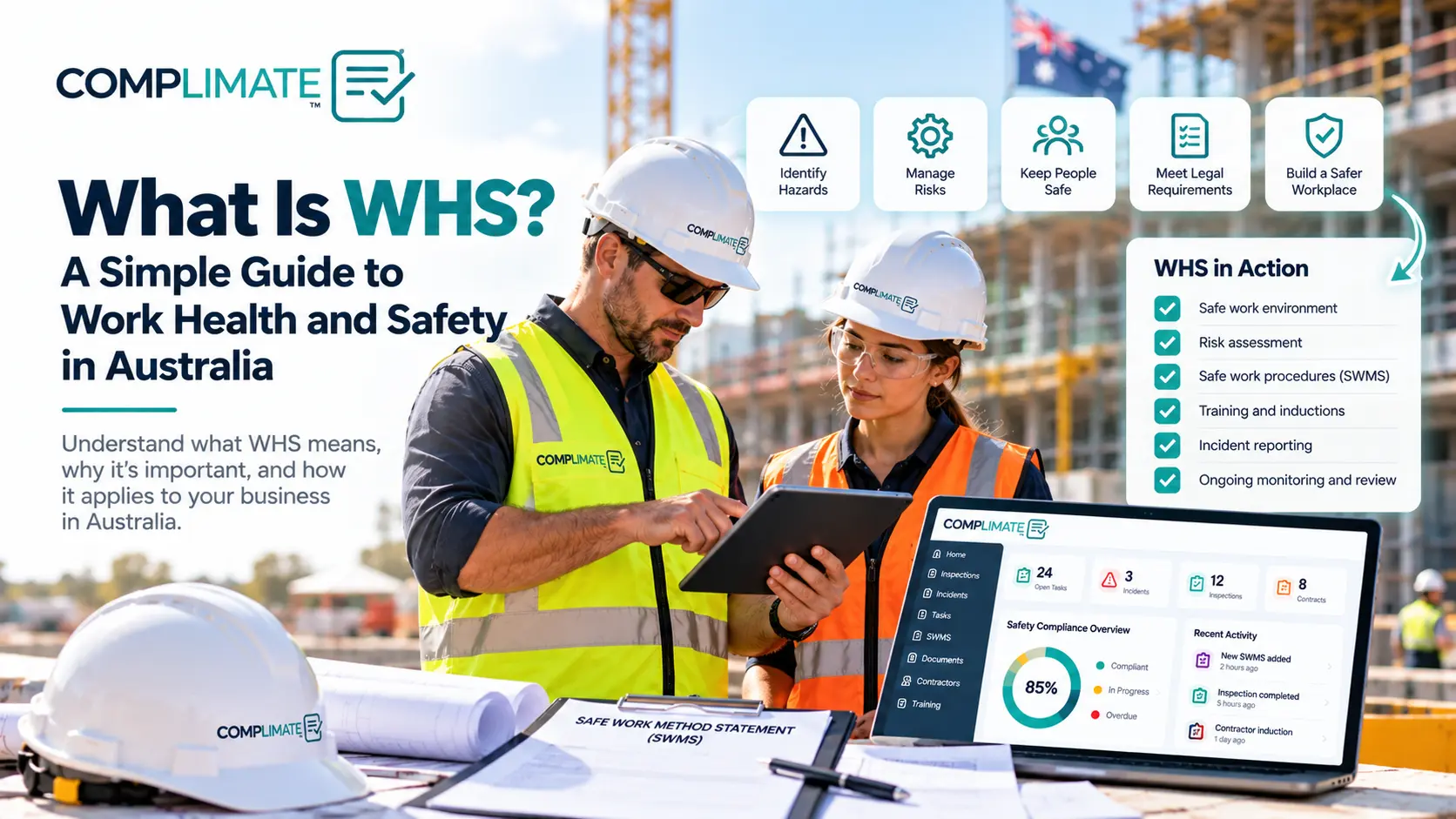
Work Health and Safety (WHS) is about protecting people from injury and illness at work. In Australia, WHS involves identifying hazards, managing risks, providing safe working conditions and making sure people understand their health and safety responsibilities.
WHS applies to more than construction sites and factories. Offices, warehouses, childcare centres, healthcare facilities and other workplaces also need to manage risks relevant to their activities.
For businesses, effective WHS means more than having a safety policy. It requires practical processes that help people work safely, report problems and follow up on identified risks.
Key takeaways
WHS stands for Work Health and Safety.
Businesses and other duty holders have legal responsibilities under applicable WHS laws.
WHS includes physical and psychological health.
Risk management, worker consultation, training and recordkeeping are important parts of WHS.
Digital tools can help organise safety documents, inspections and corrective actions, but they do not replace legal duties or professional judgement.
What does WHS mean?
WHS stands for Work Health and Safety. It refers to the systems, procedures and actions used to protect workers and other people who may be affected by work.
This includes preventing physical injuries, managing exposure to hazards and addressing risks to psychological health.
For example, a construction company may need to manage risks from working at heights, moving machinery and hazardous materials. An office may need to consider workstation ergonomics, emergency procedures, workload and workplace behaviour.
The risks differ between workplaces, so businesses need to assess their own activities rather than rely on a generic checklist.
Why is WHS important for Australian businesses?
A well-managed WHS system helps businesses identify problems early, reduce avoidable harm and maintain safer working conditions.
WHS also matters because applicable laws place duties on businesses, officers, workers and other people in the workplace. The exact requirements depend on the relevant jurisdiction and circumstances.
Good WHS practices can help businesses:
Identify hazards before they cause harm.
Give workers suitable information, instruction and training.
Record incidents, inspections and safety concerns.
Assign responsibility for resolving identified issues.
Keep important safety information organised and accessible.
Review whether safety controls are working as intended.
WHS should be part of everyday operations, not something a business reviews only before an audit.
What are the main WHS responsibilities?
Under Australia's model WHS laws, different people have different duties. The model laws have been adopted across most Australian jurisdictions, but Victoria has a separate occupational health and safety framework. Local requirements and variations should always be checked.
1. Businesses and PCBUs
A PCBU is a person conducting a business or undertaking. This can include a company, sole trader or other business operator.
A PCBU has a primary duty to ensure, so far as is reasonably practicable, the health and safety of workers and other people affected by its work.
This can involve maintaining safe work environments, managing risks, providing training and consulting workers about relevant safety matters.
Read our guide to WHS compliance software to understand how digital systems can help organise safety-related records and workflows.
2. Officers and business leaders
Officers, such as directors and certain senior decision-makers, have a due diligence duty under the model WHS laws. This includes taking reasonable steps to understand WHS matters, ensure suitable resources and processes are available, and verify that relevant duties are being met.
3. Workers
Workers must take reasonable care of their own health and safety and that of others who may be affected by their actions. They must also follow reasonable safety instructions and cooperate with notified workplace safety policies and procedures.
4. Contractors and visitors
Contractors, subcontractors and visitors may also have WHS duties. Businesses should make sure relevant people understand site hazards, access rules and the safety arrangements that apply to their work.
What are the main parts of a WHS system?
An effective WHS system brings together processes that help a business identify, manage and review workplace risks.
The right arrangements depend on the business, its activities and the laws that apply.
For construction businesses, a process for managing Safe Work Method Statements (SWMS) may also be important. Learn more about construction safety compliance and how safety documentation can support site-level processes.
How can a business manage WHS effectively?
Businesses can use the following practical steps as a starting point.
Step 1: Identify workplace hazards
Look at the work people perform, equipment they use, substances they handle and conditions they work in. Include physical and psychological hazards where relevant.
Step 2: Assess and control risks
Consider how likely harm is to occur and how serious it could be. Eliminate risks where reasonably practicable. If they cannot be eliminated, minimise them using suitable controls.
Step 3: Consult workers
Workers often understand the practical risks involved in their jobs. Ask for their input when identifying hazards, selecting controls and reviewing changes that could affect their health and safety.
Step 4: Provide suitable training and information
Make sure workers understand relevant procedures, emergency arrangements and the safe use of equipment. Review training when work or risks change.
Step 5: Record and follow up
Document relevant inspections, incidents, decisions and actions. Assign an owner and due date to each corrective action, then verify that the issue has been addressed.
Step 6: Review the system regularly
Review controls after incidents, changes to work processes, new hazards or other events that may affect safety. Periodic inspections and audits can help identify gaps that need attention.
Suggested in-article image: A safety professional inspecting a warehouse while using a tablet. Alt text: “Workplace safety inspection in a warehouse using a digital checklist.”
Can WHS software help businesses manage compliance?
Yes. WHS software can help businesses organise information and make routine safety workflows easier to track. It can be particularly useful when records are spread across spreadsheets, paper forms, email and shared folders.
Depending on the platform, features may include:
Central storage for policies, procedures and safety documents.
Digital forms for inspections and hazard reporting.
Incident and near-miss records.
Corrective action assignments and due dates.
Contractor and training records.
Audit evidence and document review tracking.
For example, an inspection may identify a damaged piece of equipment. A connected workflow can record the finding, assign someone to address it, set a deadline and retain evidence of the follow-up.
Complimate's safety management software helps businesses organise safety documentation, audits, digital forms and corrective actions in one platform.
Software supports the process; it does not automatically make a business compliant. Businesses remain responsible for understanding and meeting their applicable WHS obligations.
Frequently asked questions about WHS
What does WHS stand for in Australia?
WHS stands for Work Health and Safety. It refers to the duties, processes and practices used to protect people from work-related injury and illness.
Is WHS mandatory for Australian businesses?
Applicable WHS or occupational health and safety laws impose duties on businesses and other duty holders. The precise requirements depend on the jurisdiction, industry and work being performed.
What is the difference between WHS and OHS?
WHS means Work Health and Safety, while OHS means Occupational Health and Safety. Both concern workplace health and safety. The terminology and legal framework used depend on the jurisdiction; Victoria, for example, uses an OHS framework rather than the model WHS laws.
What is a WHS management system?
A WHS management system is the set of policies, procedures, responsibilities and processes a business uses to manage workplace health and safety risks. It may include risk assessments, training, inspections, incident reporting and corrective actions.
Do small businesses need WHS procedures?
Small businesses still need to meet the duties that apply to them. Their processes should be appropriate to the nature and level of their risks. A small business may need fewer formal systems than a large organisation, but it should not ignore relevant hazards or legal responsibilities.
Can WHS software guarantee compliance?
No. Software can help organise documents, track actions and support safety processes, but it cannot guarantee compliance. Businesses must use the system properly and check that their arrangements meet applicable legal requirements.
Final thoughts
WHS is about protecting people through practical, ongoing risk management. Australian businesses need to understand their responsibilities, involve workers, maintain suitable controls and follow up when problems are identified.
As a business grows, managing documents, inspections, incidents and corrective actions across multiple teams or sites can become harder. A structured WHS process, supported by suitable software where useful, can make this work easier to manage and review.
If your business wants a more organised way to manage safety documents, audits and follow-up actions, explore Complimate's WHS and compliance management platform.